Finance Seminar Archive
The archive provides an overview of previous lectures by renowned international researchers and presents a wide range of topics and advances in real estate research. It serves as evidence of our ongoing commitment to academic dialogue and excellence.
Prof. Dr. Dan Greenwald: Financial and Total Wealth Inequality with Declining Interest Rates
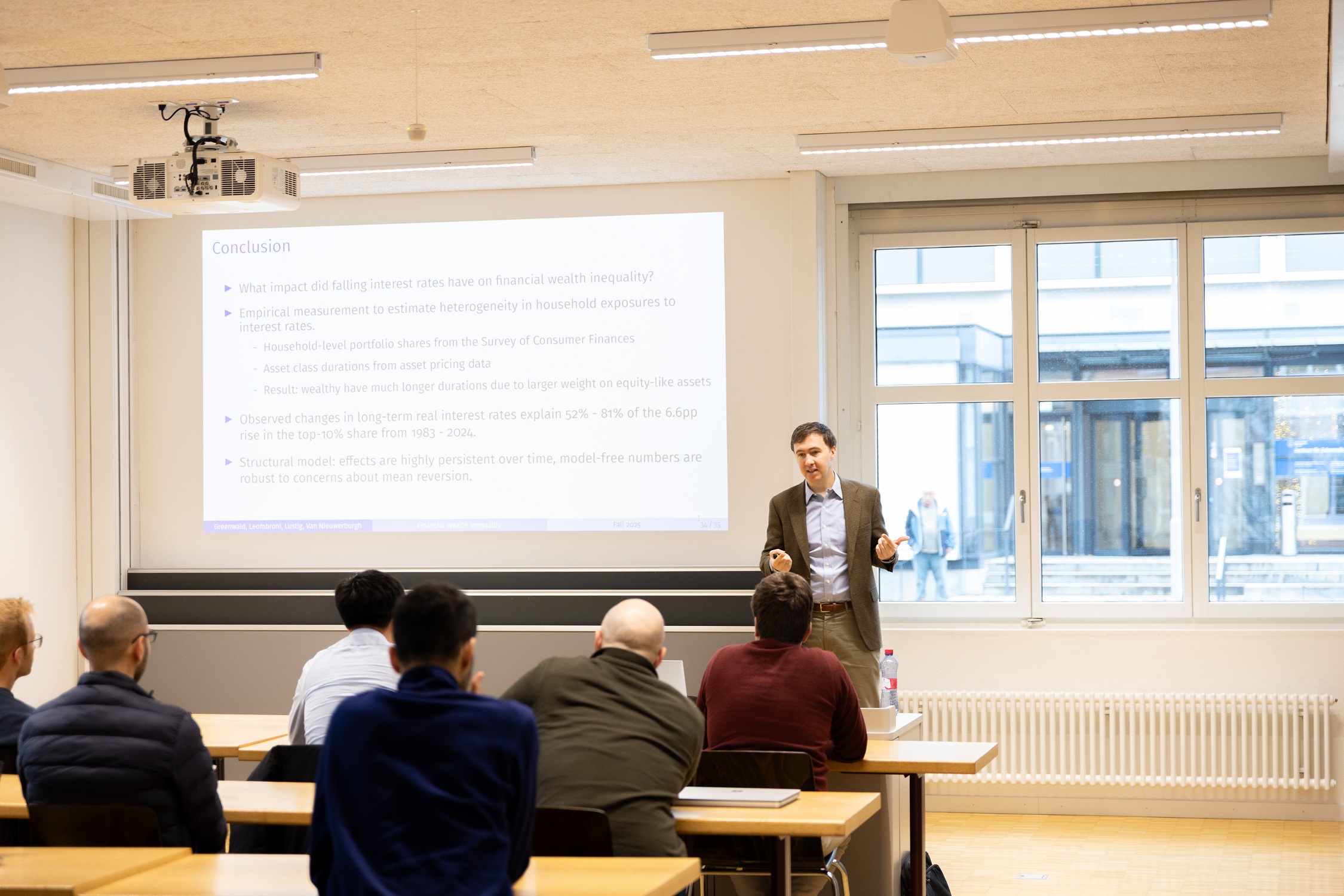
Dan Greenwald is Assistant Professor of Finance at the NYU Stern School of Business. His research is at the intersection of macroeconomics and finance, with special focus on housing and mortgage markets, the links between the stock market and the macroeconomy, and the structure of corporate debt.
Interview
What is the main focus of your research?
My research explores the connections between financial markets and the macroeconomy. My main line of research focuses on debt markets, where I study how real-world institutional details of how debt contracts and debt limits are arranged matter for macroeconomic outcomes. For example, I have studied the role of payment to income limits on mortgages in driving the response of house prices to interest rates and the 2000s housing boom. In other work, I investigated how debt covenants, credit limit facilities, and bank regulatory accounting affect how banks and firms react to macroeconomic shocks. In a secondary line of research, I study how financial markets interact with inequality, arguing that redistribution between workers and shareholders has been the largest contributor to rising stock values since the 1980s, and that falling interest rates have been the primary driver of financial wealth inequality over the same period.
What is a key finding of your research?
A key finding of my research on housing and mortgages is the importance of payment to income limits, also known as “DTI” limits or debt service limits. These limits cap the percentage of a borrower’s income that can be used to make mortgage payments. These limits are less studied than loan to value limits, but can have powerful effects in mortgage markets. In my work, I argued that a loosening of payment to income limits appears to be the most important change to credit standards in driving the 2000s housing boom. The key idea is that when house prices are booming, loan to value limits that allow borrowing proportional to the value of a property, are ineffective at stopping the boom as they allow for very large loans, particularly for the population of existing homeowners responsible for most mortgage and housing transactions. In contrast, payment to income limits can become tightly binding during an environment with booming house prices, as incomes typically do not rise as much as house prices during these periods. I show empirically that these payment to income limits were massively loosened during the 2000s, likely to alleviate these pressures, and contributed heavily to the size of the housing boom, explaining around one-third to one-half of the total rise in house prices relative to rents over this period. These results indicate that limits based on income, not the value of the property, are the key macroprudential tools to limit the size of housing booms.
What inspired you to focus on the study of real estate markets?
I was inspired to study real estate markets because they are so important to the typical household. While equity and bond markets are large, they are highly concentrated among the wealthiest households. In contrast, the typical household in the US has their balance sheet dominated by a single asset (a house) and a single liability (a mortgage). Understanding this market helps us to understand the financial life of typical households, who are very important for macroeconomic aggregates like consumption, and who may benefit more from marginal changes in policy compared to wealthy investors.
In your opinion, what emerging trends or issues in the real estate market are likely to gain importance in the coming years?
There are many trends that will be interesting to keep an eye on in the coming years. First, whether the prevalence of “locked in” households with very low mortgage rates, who face high disincentives to move or refinance, will persist and continue to have a large effect on real estate markets. Second, whether the challenges of younger households in buying high-priced housing will continue, and how aging and bequests of older households might affect this situation. Third, whether institutional investments in rental housing, particularly single family housing, will continue to expand.
Prof. Dr. Arpit Gupta: Property Taxes and Housing Allocation Under Financial Constraints

Arpit Gupta is an Associate Professor of Finance at the Stern School of Business, New York University. His research focuses on real estate markets, household finance, and urban economics, with an emphasis on market frictions such as illiquidity, information asymmetries, and financial constraints. His recent work explores the effects of remote work on housing markets and the role of zoning regulations in housing affordability. He holds a Ph.D. in Economics from Columbia University.
Interview
What is the main focus of your research?
My research focuses on how real estate affects household balance sheets and economic outcomes. My focus is on the frictions in real estate markets — such as information asymmetries, illiquidity, and financial constraints — and how they impact household welfare and decision-making. Much of my recent work focuses on the role of housing regulations such as zoning on housing affordability. Here, I have been very excited to explore new LLM tools to systematically process and categorize the contents of a large number of municipal zoning documents.
What is a key finding from your research, and how does it impact everyday life, the real estate industry, or policymaking?
A key finding has been the disruptive role of remote work for both residential and commercial real estate markets. My work has found that the post-pandemic period has seen a huge rise in suburban migration in the United States, leading to increases in suburban house prices, at the cost of urban cores (and especially the valuations of office buildings in these cores), as fully-remote and hybrid work has taken off. This finding points to important challenges for urban environments in the years to come.
What inspired you to focus on the study of real estate markets?
I graduated college in 2009, and saw first hand the broad implications of real estate for economic fluctuations and outcomes. At the same time, I realized that data availability was increasing strongly in the area, which made it a good fit for applying modern econometric techniques.
In your opinion, what emerging trends or issues in the real estate market are likely to gain importance in the coming years?
Ongoing innovations in transportation technology — including self-driving cars (AVs) and electronic vehicles (EVs) are likely to reshape urban environments, and thereby impact real estate values. Additionally, many markets around the world are facing large drops in fertility. This depopulation may result in substantial value declines in real estate around the world if trends continue.
Prof. Dr. Lu Liu: A Macro-Finance Model of Mortgage Structure

Lu Liu is an Assistant Professor of Finance at The Wharton School, University of Pennsylvania. Her research focuses on household decisions in housing and mortgage markets, examining their macroeconomic implications and informing policy and market design. She holds a Ph.D. in Finance from Imperial College London.
Interview
What is the main focus of your research?
My research explores how households make decisions in the housing and mortgage markets and the broader economic impact of these choices. This includes decisions about mortgages, moving, selling, and refinancing, as well as the challenges and trade-offs households face. For example, my work on "mortgage lock-in" examines how low fixed rates discourage homeowners from moving when market rates rise, affecting housing markets and labor mobility. I also study how different mortgage structures impact financial stability and risk sharing.
What is a key finding from your research, and how does it impact everyday life, the real estate industry, or policymaking?
A key finding is how "mortgage lock-in" reduces mobility and reshapes the housing market. In the U.S., many homeowners have locked in low rates of around 4% - for up to 30 years, but moving would mean remortgaging at higher market rates, close to 7%, significantly increasing costs. This financial burden keeps people in their homes, leading to fewer houses on the market, high prices, and challenges for first-time buyers.
For the real estate industry, this suggests the need for innovative solutions, like mortgages that can be transferred when moving. For policymakers, my research highlights the importance of targeted strategies to help first-time buyers, rather than relying solely on subsidies.
What inspired you to focus on the study of real estate markets?
I wanted to understand the connections between households and financial markets. During my time at the Bank of England, I saw how crucial mortgage and housing markets are for transmitting monetary policy to the economy. Mortgages also vary greatly across countries, raising important questions about how design choices affect economic stability and what lessons we can learn to build better housing finance systems.
In your opinion, what emerging trends or issues in the real estate market are likely to gain importance in the coming years?
Recent rate rises turned out more persistent than initially expected, so I think it will be interesting to understand the long-term implications of mortgage lock-in on housing markets and labor reallocation. Mortgages also continue to play a role for on-going vulnerabilities in the financial sector. Lastly, housing affordability and unequal housing access are likely to remain important topics for the future.